
Uncategorized
Sesame Seeds: Africa’s Quiet Power Play in Global Commodities (2026 Outlook)
Jan
By Francisca Ochieng | January 2026
Why Sesame Matters to Serious Capital
Global commodity capital has traditionally flowed toward energy, metals, and the major grain complexes traded on CBOT and ICE. Yet beneath the surface, a smaller class of agricultural commodities is quietly demonstrating the characteristics long-term investors prize most: structural demand, geographic supply shifts, fragmented price discovery, and durable real-economy relevance.
Sesame seeds sit squarely in that category.
Often overlooked due to the absence of a centralized futures contract, sesame has evolved into a strategically important soft commodity—particularly as Africa emerges as the world’s most consequential supply region.
This article presents a fact-driven assessment of the sesame market as it stood in 2025 and outlines a realistic, investor-grade outlook for 2026.
Sesame’s Demand Profile
Sesame is not a speculative novelty crop. It is a globally consumed industrial and food commodity embedded across multiple demand verticals:
- Staple food manufacturing (bakery, confectionery, tahini)
- High-value edible oils
- Cosmetics and personal care
- Nutraceutical and functional food formulations
Unlike trend-driven commodities, sesame consumption is structural and non-cyclical. It is deeply woven into Asian, Middle Eastern, and Mediterranean diets and increasingly integrated into Western health-food supply chains.
This demand resilience is precisely why sesame has sustained trade volumes and pricing power even when broader agricultural markets softened.
2025 Market Reality: Fragmented but Revealing
In 2025, global sesame pricing did not move as a single curve. Instead, prices reflected origin quality, logistics, certification, and timing:
- Conventional white sesame traded largely within USD 1,700–2,000 per metric tonne (FOB/CFR depending on origin).
- Premium grades—including black sesame, organic-certified, and low-aflatoxin lots—regularly achieved USD 2,300–2,700 per tonne.
- Asian port inventories, particularly in China, created short-term volatility and localized price distortions rather than sustained global swings.
This dispersion is not a weakness—it is an opportunity. Markets without centralized futures contracts reward participants who understand physical flows, port stocks, and quality differentials.
Africa’s Structural Ascendancy
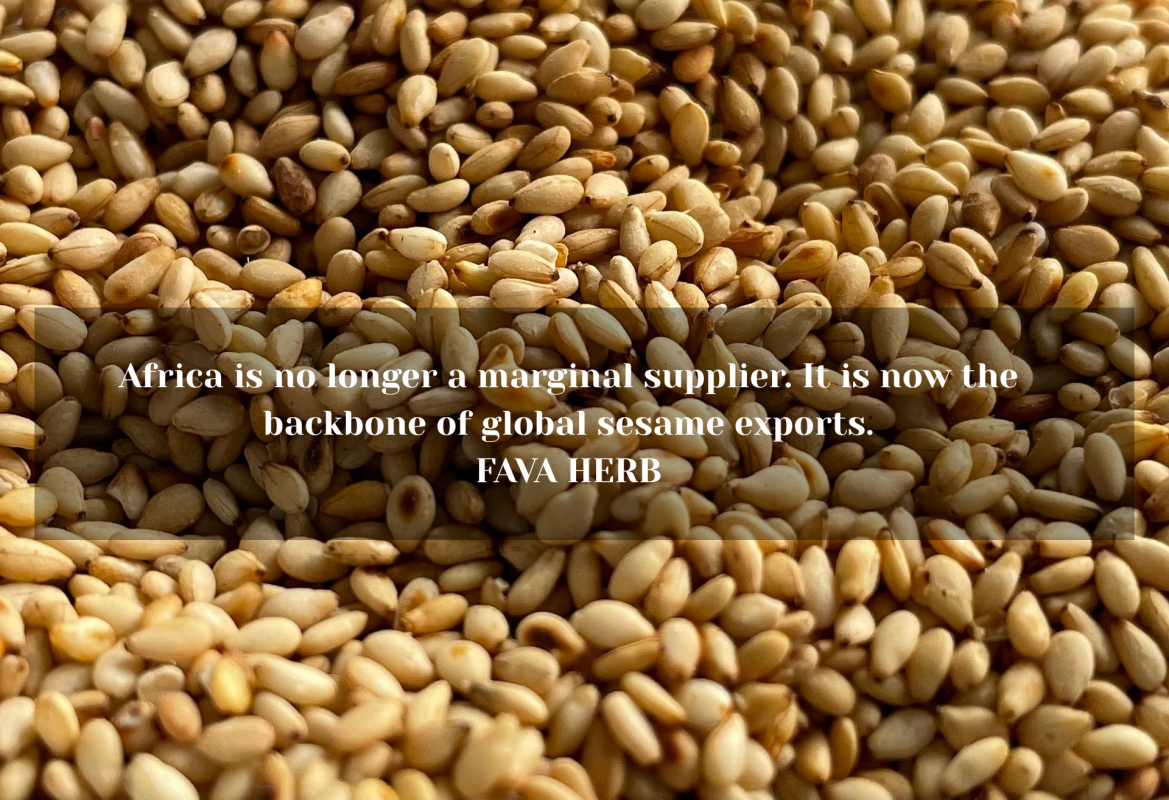
The most important shift in the sesame market over the past decade has been geographic. Africa is no longer a marginal supplier. It is now the backbone of global sesame exports.
Countries such as Sudan, Nigeria, Tanzania, Ethiopia, and Burkina Faso collectively account for a dominant share of internationally traded sesame. Several structural advantages underpin this rise:
- Agro-climatic suitability — Sesame thrives in semi-arid regions with minimal irrigation—conditions increasingly common across Africa.
- Cost competitiveness — African production remains cost-efficient relative to Asian origins, even after logistics.
- Scale potential — Expansion capacity remains significant, particularly through contract farming and yield optimization rather than land conversion.
Historically, African sesame traded at a discount due to inconsistent post-harvest handling and quality assurance. That gap is now closing rapidly where exporters invest in cleaning, drying, sorting, and laboratory testing. The result: African origin sesame is moving from “cheap supply” to strategic supply.
Price Discovery Without Futures: A Feature, Not a Flaw
Sesame is not actively traded on CBOT or ICE. Instead, prices are discovered through:
- Forward physical contracts
- Regional exchanges (e.g., India)
- Port-based spot markets
- Bilateral long-term supply agreements
For institutional capital, this means reduced speculative noise and closer linkage to real supply-demand fundamentals.
In practical terms, it allows disciplined traders and investors to:
- Lock margins through forward origination
- Exploit quality premiums
- Arbitrage logistics inefficiencies
- Structure off-exchange contracts with downside protection
This is closer to how investors historically approached commodities exposure: owning or controlling advantaged positions within real supply chains, not chasing screen volatility.
2026 Outlook: Three Scenarios Investors Should Consider
Base Case (Most Probable):
- Prices stabilize within USD 1,800–2,300 per tonne for standard white sesame.
- African supply growth offsets Asian volatility.
- Premium grades continue to command structural premiums.
Bull Case:
- Weather disruptions or geopolitical constraints in Asia tighten supply.
- Spot prices for high-grade sesame exceed USD 2,500 per tonne in key import windows.
- Quality-certified African exporters outperform.
Bear Case:
- Rapid African production growth outpaces quality infrastructure.
- Low-grade bulk supply pressures prices toward USD 1,500–1,700 per tonne.
- Differentiation between certified and non-certified exporters widens sharply.
Across all scenarios, quality and logistics—not volume alone—determine profitability.
What Sophisticated Capital Is Doing Differently
The most successful participants in the sesame market are not spot traders. They are builders.
They:
- Secure forward volumes directly from origin
- Invest in post-harvest infrastructure
- Finance quality upgrades
- Build traceable, bankable supply chains
- Think in seasons, not weeks
This approach converts sesame from a volatile agricultural input into a repeatable cash-flow commodity.
Fava Herb’s Strategic Position
Fava Herb operates where capital efficiency and real-economy impact intersect:
- African origin sourcing with verified supply relationships
- Quality-first handling aligned to international buyer standards
- Commercial structures that match institutional expectations
In markets where information asymmetry and operational gaps still dominate, execution becomes the moat.
Closing Thought
Sesame will never dominate headlines like oil or copper. That is precisely why it deserves attention.
It is a commodity where discipline beats speculation, where Africa’s rise is structural, and where long-term capital can still earn real returns by backing the right supply chains.
For investors willing to look beyond the obvious, sesame is not a niche—it is a signal.

Book: Returning To Nature’s Ancient Pharmacy -An African Approach To Natural Remedies
What You’ll Discover:
- Daily Herbal Remedies backed by Scripture and tradition
- Natural healing foods like raw honey, fermented drinks, and superfruits
- Uses of animal fats like tallow, ghee, and bone broth
- African healing plants like hibiscus, tamarind, and baobab
- Teas and Adaptogens for stress, energy, and hormone balance
- Spiritual insights on God’s design for healing and wellness
- Practical recipes, homemade remedies, and devotional reflection

