
Uncategorized
Iron, rails and returns: why East Africa’s steel dream will live or die on logistics, offtakes and Simandou
Mar
By Fava Herb
East Africa has the ingredients for a new steel story — iron deposits, rising regional infrastructure demand and political will — but the denominating risk is simple and brutal: transport, timing and global supply will decide whether geology becomes profit. Put another way: ore matters only when it reaches a mill or a ship cheaply and on time. For investors weighing projects from Tanzania’s Liganga to Uganda’s new Tororo mill, the central commercial question is whether local value-chains and finance can be stacked fast enough to outrun the price pressure that Guinea’s Simandou and a cooling Chinese market will exert.
Global context first. Benchmark 62% Fe fines traded at roughly USD 108/tonne in early January 2026 — down sharply from 2021 peaks and at a level that strains marginal, high-cost projects. At these prices, projects that cannot match the low cost of Australia/Brazil or capture downstream margins are unlikely to deliver attractive risk-adjusted returns. Meanwhile, China’s crude-steel output and apparent consumption have softened, and policy focus on capacity control further reduces the upside for new seaborne demand.
Enter Simandou. Guinea’s integrated scheme — backed by Rio Tinto and partners and supported by a ~600–670 km rail and new port build — plans to ramp to tens of millions of tonnes per year (Rio Tinto cites an annualised capacity of ~60 Mtpa for SimFer and partners discuss combined infrastructure capacity of up to ~120 Mtpa) once commissioning completes. The development cost and logistics scale (reported investment frameworks run into the US$15bn range for rail/port) mean Simandou will be a durable low-cost Atlantic supplier: a structural downward pressure on seaborne prices that raises the hurdle rate for East African projects.
That is the market backdrop. How do East African projects stack up?
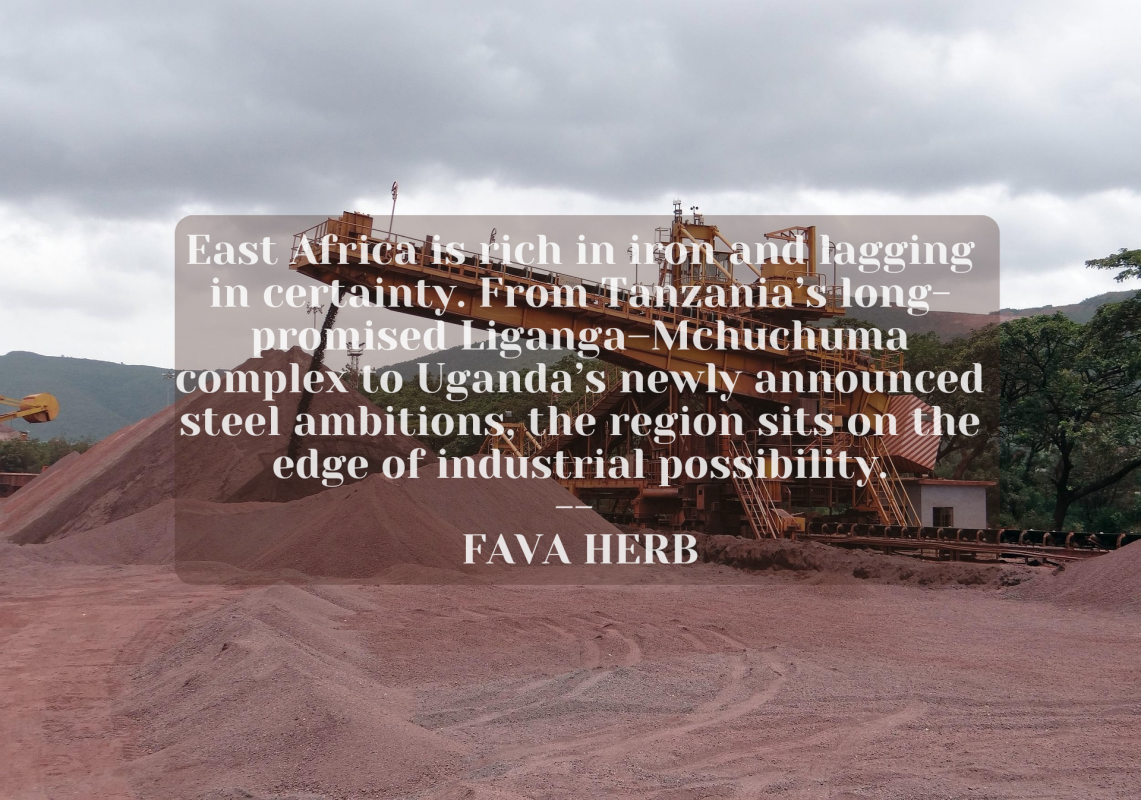
Tanzania’s Liganga–Mchuchuma remains the region’s marquee proposition. Official surveys report ~126 million tonnes of drilled iron ore in the Liganga area and government planning documents envisage an integrated package: a ~2.9 Mtpa iron mine, a 1 Mtpa steel plant and a 600 MW power station at Mchuchuma — a package sometimes discussed within a roughly US$2.5–3.0bn investment envelope. Integration is the right commercial instinct: by converting ore into steel domestically, the project hedges against volatile export prices and captures more value. But history warns: Liganga has been on the books for decades, repeatedly delayed by financing, rail-and-power shortfalls and environmental and resettlement complexities. Execution risk is high, and each slippage further narrows the window before global supply and price dynamics shift.
Kenya’s experience provides a cautionary policy lesson. An export levy on iron ore (reported at roughly USD 175/t) aimed at protecting downstream industry has had the perverse effect of discouraging mining investment where seaborne prices are lower than the levy — essentially sterilising deposits rather than catalysing beneficiation. Policy that seeks value-addition must balance short-term protection with incentives that attract the capital needed to develop scalable mines and associated infrastructure.
Uganda’s newly launched Devki Tororo project — a US$500m plant expected to target about 1 Mtpa of finished steel — is exactly the sort of demand-anchor that could change the game if matched by reliable regional ore supply and rail links. Governments argue Africa’s steel demand is rising — estimates put continental consumption near ~39–40 Mt in 2024, rising toward the low-50s Mt by the early-to-mid 2030s — creating a plausible domestic market that regional mills might serve. But demand projections do not remove the logistics constraint: mills fail if feedstock, power and transport are intermittent or expensive.
From an investor’s perspective the implications are concrete:
• Prioritise integrated offtake and captive logistics. Projects that bundle mine, rail and port (or long-term rail access agreements) materially de-risk cash flows and are more likely to secure senior lending. Simandou succeeds because it built infrastructure first; East African projects must replicate that logic at smaller scale.
• Value domestic demand but stress-test it. Contracts with regional steelmakers (captive offtake), government backing for predictable power and transport, and competitive local pricing will determine whether mills can run profitably when seaborne prices are weaker.
• Price and carbon scenarios matter. Model returns at iron-ore prices of US$80–120/t (not the 2021 highs), and under both coal-intensive and lower-carbon energy mixes — financiers are increasingly pricing carbon risk into cost of capital. Projects reliant on coal-fired power face higher financing hurdles and potential stranded-asset risk.
• Policy engagement is an investment—treat it as such. Export levies, local content rules and land compensation regimes materially affect timelines and economics. Investors should insist on transparent, time-bound policy frameworks and escrowed guarantees for compensation and permits.
East Africa’s comparative advantage will not be geology alone but the speed and credence with which governments and investors can assemble offtake, finance and the rails to move tonnes. If Liganga becomes a working integrated complex and regional mills like Devki’s plant secure stable feedstock and transport, East Africa can capture meaningful industrial rent. If not, it risks becoming a ledger of attractive deposits that never reach profitable production — precisely the outcome that a ramp-up at Simandou will make ever harder to reverse. The arithmetic, not the ambition, will decide the winner.

Book: Returning To Nature’s Ancient Pharmacy -An African Approach To Natural Remedies
What You’ll Discover:
- Daily Herbal Remedies backed by Scripture and tradition
- Natural healing foods like raw honey, fermented drinks, and superfruits
- Uses of animal fats like tallow, ghee, and bone broth
- African healing plants like hibiscus, tamarind, and baobab
- Teas and Adaptogens for stress, energy, and hormone balance
- Spiritual insights on God’s design for healing and wellness
- Practical recipes, homemade remedies, and devotional reflection

