

Agriculture
Designed to Exclude: Africa’s $117 Billion Agricultural Finance Crisis
Aug
Designed to Exclude: Africa’s $117 Billion Agricultural Finance Crisis
The following is the full text of the keynote address delivered by Fava Herb at the Africa Food Show Kenya 2026 at the Kenyatta International Convention Centre, Nairobi, on 19 August 2026. The address examines the structural exclusion of smallholder and medium-scale farmers from Africa’s formal financial system, names the financing architecture responsible, and prescribes the blended finance, agricultural credit scoring, and bundled insurance instruments that evidence confirms can change it.
She Is Told No
She rises before the sun. She works land her grandmother worked, and her grandmother’s grandmother before her. She knows the soil by texture, by smell, by what it yields in a wet year and what it withholds in a dry one. She feeds her community. She contributes — quietly, consistently, without recognition — to the GDP of her nation.
And when she walks into a bank and asks for a loan to buy certified seed, to lease a tractor for one season, to build a small storage shed so her harvest does not rot before it reaches the market —
She is told no.
Not because she is not creditworthy. Not because she has no assets. But because the financial system she is standing inside was not built with her in mind. It was built around her, over her, and in many ways, against her.
Not a Financing Gap. A Financing Architecture.
What Africa’s agricultural sector confronts is not a financing gap. A gap implies an accident, an oversight, a distance between two points that simply needs to be bridged. What we are confronting is something far more deliberate. It is a financing architecture — and architectures are built by design.
“We have not failed to fund Africa’s farmers because we lacked the capital. We have failed because we lacked the will to redesign who capital is for.”
Banks require collateral. In most of sub-Saharan Africa, smallholder farmers hold land under customary tenure — land that cannot be formally titled, and therefore cannot be pledged. Development finance institutions arrive with instruments calibrated for corporate agribusiness. Their minimum ticket sizes, their compliance requirements, their governance standards — these were engineered for a borrower that Africa’s agricultural sector, at its most productive tier, does not resemble.
The Numbers: A Continent Built on 33 Million Farms It Refuses to Finance
The scale of the mismatch between agricultural contribution and agricultural finance in sub-Saharan Africa is not a matter of interpretation. It is a matter of record.
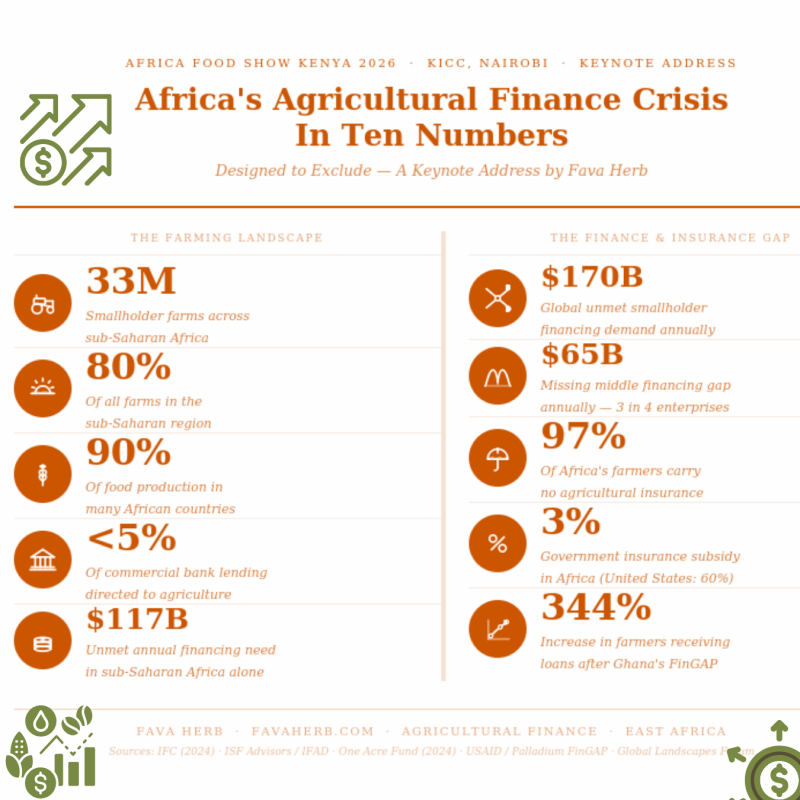
We have built an economy on the foundation of 33 million farms — and directed less than a twentieth of our formal financial system toward them.
In Nigeria, where agriculture accounts for 25% of GDP, only 5.3% of commercial bank lending reaches the sector. In Ghana, that figure is 4%.
Source: IFC · SAFIN Network · Empower Africa (2026)Not Millions. Billions. Every Year.
The IFC estimates an unmet financing need of $117 billion annually across agri-SMEs and smallholders in sub-Saharan Africa alone. For smallholder farmers worldwide, the unmet demand reaches $170 billion every year — with financiers meeting less than half of what is needed.
Microfinance fills the bottom of the pyramid — loans sufficient to buy inputs for one acre, not fifteen. At the top, commercial banks serve large-scale agribusiness. And in between sits a population that the financial system has been designed, functionally if not intentionally, to ignore.
The Missing Middle: A $65 Billion Financing Gap
The farmer operating between five and two hundred acres. Too large for microfinance. Too small for commercial banking. Too geographically dispersed for institutional investors. Too economically significant to be ignored — and yet, ignored systematically.
“They are not invisible because they are unproductive. They are invisible because we designed a system that cannot see them.”
Research puts the financing gap for the missing middle at $65 billion annually — representing three in four agricultural enterprises across sub-Saharan Africa that cannot access formal capital. This is not a fringe population. Across East Africa alone, millions of farming households operate at precisely this scale — the scale at which agricultural transformation is most leverageable, most likely to produce the food security and rural employment outcomes that governments have pledged in every policy document written in the last thirty years.
The Agricultural Insurance Crisis: 97% of Africa’s Farmers Are Unprotected
Ninety-seven percent of farmers in Africa carry no agricultural insurance. Not three percent uninsured. Ninety-seven. Sub-Saharan Africa is the only region in the world without subsidized crop insurance widely available to its farming population.
A failed season in Iowa is a setback. A failed season in Busia, Meru, or Kirehe can be the end of everything — the children pulled from school, the livestock sold, the household pushed below a poverty line it may take years to climb back above. The weight of drought, flood, erratic rainfall, and climate volatility falls entirely on the farmer. There is no net below them.
“We insure buildings, automobiles, and corporate revenue streams — and we leave the people who feed nations to absorb risk entirely alone.”
Kenya’s agricultural insurance market underlines the continental picture. Fewer than one percent of farmers in Kenya carry any form of agricultural insurance. The Kenya Agricultural Insurance Programme (KAIP), while promising, has faced persistent challenges of basis risk, weak institutional capacity, and limited farmer awareness that have constrained its effectiveness. As of 2022, weather index insurance uptake among eligible Kenyan smallholders stood at just 12.7 percent — a figure the IFPRI-government strategic partnership begun in July 2025 is working to improve through dynamic index triggers aligned to crop phenology.
Bundling Credit with Crop Insurance: The Integrated Solution
Any serious conversation about agricultural financing must now bundle risk protection alongside credit. Crop insurance and lending cannot continue to live in separate policy silos. The logic is straightforward and the mechanism is proven.
When a commercial lender extends credit to a smallholder or medium-scale farmer, that loan is exposed to the same climate risks the farmer faces. When we insure the crop, we de-risk the loan. When we de-risk the loan, we make the lender willing to lend. The instrument that protects the farmer also opens the door to the capital the farmer needs.
Bundling credit with index-based parametric insurance — triggered by satellite-verified weather events rather than costly individual claim assessments — is not a luxury innovation. It is the architecture of a functional agricultural finance market. Kenya has moved in this direction: the Insurance Index Regulations 2025, drafted by the National Treasury, will require insurers to settle parametric insurance claims within ten days, a critical measure for rebuilding farmer trust in the instrument.
“A loan without risk protection is a debt trap waiting to be sprung.”
Proof Points: Blended Finance That Worked
This is not a theoretical argument. The architecture has been built — when we chose to build it. Two documented cases across the continent confirm that blended finance, structured correctly, does not merely disburse money. It builds markets.
The FinGAP programme simultaneously addressed barriers limiting agricultural financing by restructuring Ghana’s agri-finance ecosystem. It worked with smallholder farmers, agribusinesses, business advisory service providers, and financial institutions, designing incentives to stimulate the flow of finance to the agriculture sector.
When donor funding ended, financial institutions continued to compete for agricultural lending.
Because the market had been made real. That is the standard blended finance must be held to — not whether it disbursed money, but whether it built a market that persisted after the donor left.
In Rwanda’s Kirehe district, a blended finance vehicle targeted smallholder cooperatives across seven agricultural value chains, helping them leverage private investment and funds from financial institutions. The result was not a spreadsheet of disbursements.
The result was the physical construction of processing plants, greenhouses, warehouses, and drying facilities — infrastructure that changed the economics of farming in that district permanently.
These are not experiments. These are proof points.
The question is not whether blended finance works. The question is why we have not scaled it.
The Prescription: Three Instruments That Can Change the Architecture
The prescription is clear. What is required is not a new conversation — it is a commitment to three instruments for which evidence already exists, and which require only political will and institutional design to deploy at scale.
First-Loss Facilities
Sovereign instruments through which governments absorb the initial layer of risk, changing the calculus for commercial lenders. Nigeria’s NIRSAL, capitalised at $500 million, guaranteed over $69 million in agricultural loans in 2025 alone. This model is replicable.
Agricultural Credit Scoring
Satellite yield data, mobile money transaction histories, and cooperative payment records. The information needed to assess a farmer’s creditworthiness without a land title exists today. What is missing is the institutional will to use it as underwriting infrastructure.
Bundled Credit and Insurance
Credit and crop insurance together in a single instrument, reaching the smallholder and the missing middle simultaneously. Parametric insurance triggered by satellite-verified weather events, paid within ten days. A loan without risk protection is a debt trap waiting to be sprung.
A Question for Every Room That Claims to Care About African Agriculture
We have spoken, for decades, about feeding Africa. We have published strategies, convened summits, and signed declarations. But the woman described at the opening of this address is still being told no at that bank counter. And every no she receives is not simply a failed transaction.
It is a harvest that will not be planted. A family that will not be fed. A nation that will not be nourished.
We have not failed to fund Africa’s farmers because we lacked the capital.
We have failed because we lacked the will to redesign who capital is for.
Are we finally ready to build a system that was designed to include?

Book: Returning To Nature’s Ancient Pharmacy -An African Approach To Natural Remedies
What You’ll Discover:
- Daily Herbal Remedies backed by Scripture and tradition
- Natural healing foods like raw honey, fermented drinks, and superfruits
- Uses of animal fats like tallow, ghee, and bone broth
- African healing plants like hibiscus, tamarind, and baobab
- Teas and Adaptogens for stress, energy, and hormone balance
- Spiritual insights on God’s design for healing and wellness
- Practical recipes, homemade remedies, and devotional reflection

