
Fishery
Omena, Small Pelagics: The Trade Statistcs on The Fish That Feeds Everyone Else
Oct
Fava Herb Fish & Aquaculture Report — Issue III of V
Small Pelagics: The Fish That Feeds Everyone Else
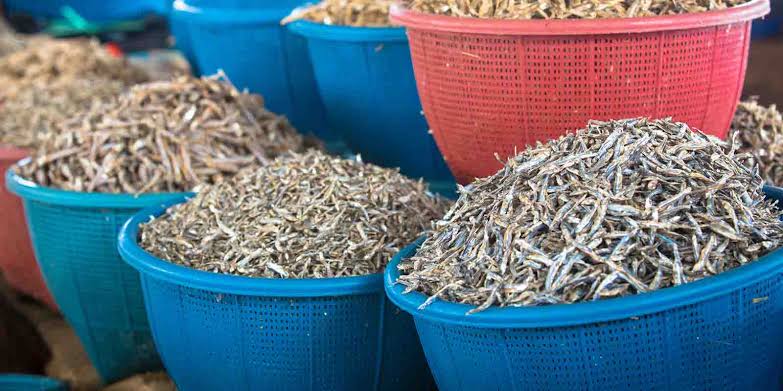
Dagaa, omena, mukene — three names for the same tiny silver fish that makes up nearly three-quarters of everything pulled out of Lake Victoria. It feeds two million livelihoods and a growing aquaculture industry, yet four in five kilograms never reach a human plate at all.
Every fish issue in this series so far has centred on a single named species with its own export story — Nile perch and its swim bladder, tilapia and its cages. Small pelagics are different: no single fish in this series moves more volume, touches more livelihoods, or is more taken for granted than the silver cyprinid known as omena in Kenya, dagaa in Tanzania, and mukene in Uganda.
01The fish underneath the export headlines
Even though Kenya governs just 6% of Lake Victoria’s surface, local silver cyprinid catches alone made up more than half of the lake’s total fish landings in the early 2010s, and by 2020 estimates put dagaa/omena/mukene’s share of total lake landings at 72%. This is, by volume, the dominant fishery on Lake Victoria — larger than Nile perch, larger than tilapia — even though it rarely appears in export statistics or trade headlines the way those two species do. The fishery employs more than two million people across fishing, processing, transport and market trade, and demand extends well beyond the three riparian states to Zambia, South Sudan, Rwanda, Malawi, the Democratic Republic of Congo, Zimbabwe and South Africa.
This is traditionally, and remains today, a fishery built and run substantially by women. Processing is typically done by hand at the landing site: fish are laid out to dry directly on rocks, sand, or old fishing nets spread across the beach, a method requiring almost no capital but producing highly inconsistent results.
02The quality collapse: why most of the catch never reaches a plate
The traditional open-air drying method is this fishery’s central economic problem. Because fish dry directly on sand, rocks or grass, the resulting product frequently contains grit and plant debris that render it unfit for human consumption at premium quality. Industry estimates suggest roughly 80% of sun-dried catch ends up graded as substandard — suitable only for the animal feed market rather than direct human food, despite the fact that dagaa/omena/mukene is one of the most important affordable protein sources for lakeside communities.
The forces pulling this fish toward feed rather than food are intensifying. Fewer than 30% of dagaa harvested in the region is used directly as human food, with the remainder — the majority of the catch — going into industrial feed mills as raw material for poultry, fish and livestock feed. The expansion of tilapia cage aquaculture covered in Issue II of this series has only sharpened this competition: growing aquaculture operations need fishmeal, and dagaa/omena is a primary domestic source, creating direct demand-side competition between feeding farmed fish and feeding people.
Kenya, Uganda and Tanzania each operate under different fisheries regulations, enforcement procedures and licensing requirements on the same shared lake, creating uncertainty for fishers and traders who move across its waters. In 2026, Lake Victoria Fisheries Organization leadership pushed regulatory harmonisation as a priority ahead of the Fisheries and Aquaculture Sectoral Council of Ministers meeting in Bujumbura, alongside a parallel push \u2014 backed by IFAD funding and solar dryer installations delivered through the Lake Victoria Small Fish Project \u2014 to replace ground-drying with solar drying technology and lift the fishery out of its structural quality trap.
03An underused resource, even before quality losses
Kenya’s own estimates suggest the omena fishery has historically operated well below its sustainable potential. The maximum sustainable yield for Kenya’s share of the omena fishery was estimated at around 190,000 tonnes, yet actual production in 2008 was only about 47,000 tonnes, valued at roughly \u20ac17 million \u2014 recovering only a quarter of the estimated sustainable catch even before accounting for the roughly 80% of that catch subsequently downgraded by poor drying. Regional cross-border trade data from the same period shows the scale of established trade routes: Uganda exported an average of 15,015 tonnes of dagaa annually to the DRC, 4,374 tonnes to Kenya, and 4,069 tonnes to South Sudan between 2010 and 2015, while the majority of Tanzania’s dagaa exports (69%) flowed to Kenya.
| Export origin | Destination | Average annual volume (2010\u20132015) |
|---|---|---|
| Uganda | DRC | 15,015 tonnes |
| Uganda | Kenya | 4,374 tonnes |
| Uganda | South Sudan | 4,069 tonnes |
| Tanzania | Kenya | 69% of Tanzanian dagaa exports |
| Tanzania | Rwanda & DRC | 31% of Tanzanian dagaa exports |
Source: WorldFish, “State of Lake Victoria Dagaa” assessment.
“Despite public concerns over overfishing, small fish catches have been increasing in Lake Victoria… the emergence of a significant aquaculture industry in tilapia has created competition for small fish like the Lake Victoria sardine, which threatens to reduce availability for consumers.”
04What this means for sourcing and finance
Small pelagics present the most straightforward quality-upgrade investment case in this entire series. Unlike Nile perch’s ecological overfishing risk or tilapia’s biosecurity gaps, the core problem here is simple and already has a proven fix: solar drying technology, already being piloted through donor-backed projects, directly converts feed-grade catch into human-food-grade product without requiring any change in the underlying fishery’s catch volume. Given that roughly 80% of current output is quality-downgraded rather than volume-constrained, drying infrastructure investment offers a more capital-efficient path to unlocking value than almost any other opportunity covered in this report series.
There is also a genuine strategic tension worth pricing into any financing structure: growing aquaculture demand for fishmeal (driven by the tilapia cage-farming boom) and growing human food demand are now competing for the same limited catch, meaning quality-upgrade investment that shifts more fish toward the human food market may face pushback from an increasingly fishmeal-hungry aquaculture sector paying comparable or better prices for lower-quality product. Regulatory harmonisation efforts across Kenya, Uganda and Tanzania, if they succeed, would also reduce the cross-border friction currently affecting established trade routes to the DRC, South Sudan, Rwanda and beyond.
The full Small Pelagics data brief
This issue’s standalone PDF goes deeper: a solar-drying investment case with unit economics, the feed-versus-food demand competition in detail, cross-border trade route data, and financing structures for processing and quality-upgrade infrastructure.
DOWNLOAD THE FULL REPORT →The Fava Herb Fish & Aquaculture Report — East Africa’s Fisheries Trade, Decoded: Omena and Small Pelagics
A five-part market intelligence series on East Africa’s fish and aquaculture economy — Nile perch, tilapia, small pelagics, Nigerian catfish, and coastal shrimp, prawn and seaweed farming. Each report pairs a free blog post with an in-depth, licensed PDF data brief covering production volumes, export markets, value chains, and financing risk across Kenya, Uganda, Tanzania, Rwanda and Nigeria.

Book: Returning To Nature’s Ancient Pharmacy -An African Approach To Natural Remedies
What You’ll Discover:
- Daily Herbal Remedies backed by Scripture and tradition
- Natural healing foods like raw honey, fermented drinks, and superfruits
- Uses of animal fats like tallow, ghee, and bone broth
- African healing plants like hibiscus, tamarind, and baobab
- Teas and Adaptogens for stress, energy, and hormone balance
- Spiritual insights on God’s design for healing and wellness
- Practical recipes, homemade remedies, and devotional reflection

