
Healthy Life
Macadamia Oil & Nuts: The Complete Guide
Sep
Macadamia Oil
& Nuts: The Complete
Kenyan Guide
Grown on the volcanic slopes of Mt. Kenya — the world’s richest dietary source of palmitoleic acid and one of the most versatile botanical oils in existence.
The macadamia nut is one of the great culinary and nutritional gifts that Kenya’s agricultural landscape has adopted and made its own. Native to Queensland, Australia, and introduced to East Africa in the mid-twentieth century, Macadamia integrifolia found in Kenya’s volcanic Mt. Kenya highlands conditions so suited to its growth that the country has become one of the world’s leading producers — and in the view of many importers and processors, a source of some of the finest macadamia available on the international market.
What makes macadamia scientifically and nutritionally distinctive is not its fat content alone — though at approximately 75% fat it is the most fat-dense nut commonly consumed — but the composition of that fat. Macadamia nuts and their cold-pressed oil contain by far the highest concentration of palmitoleic acid (omega-7) of any common food. This rare monounsaturated fatty acid — the same one found naturally in human sebum, present in diminishing quantities as skin ages — drives a set of cardiovascular, metabolic, and skin benefits that are both clinically documented and entirely unique to macadamia in the plant kingdom.
This guide covers macadamia comprehensively: from the science of its fatty acid profile and its documented health effects to the story of Kenya’s remarkable macadamia industry, and practical guidance on using both the nuts and the cold-pressed oil for maximum benefit.
What Is the Macadamia Nut?
- Botanical Name
- Macadamia integrifolia
- Plant Family
- Proteaceae
- Native Origin
- Queensland, Australia
- Kenyan Growing Region
- Mt. Kenya slopes, Central Kenya
- Fat Content
- ~75% (predominantly monounsaturated)
- Unique Fatty Acid
- Palmitoleic acid (omega-7): 17–22%
- Shell Hardness
- Hardest of any commercially harvested nut
- Oil Smoke Point
- ~210°C — high-heat cooking grade
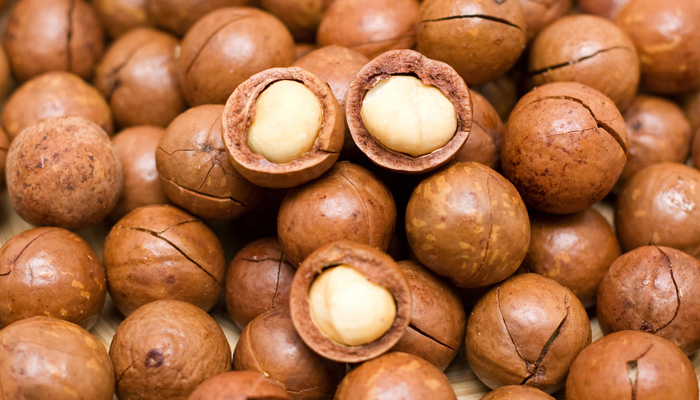
The macadamia tree is a medium to large evergreen that grows to ten to eighteen metres at maturity. It produces long, glossy, whorled leaves and drooping racemes of small cream to pink flowers. The nuts develop inside a thick, very hard wooden shell surrounded by a green outer husk. The shell is the hardest of any commercially harvested nut — approximately the same hardness as mild steel — requiring mechanical cracking rather than the hand-cracking that processes softer nuts. Inside is the creamy white kernel: rich, buttery, and mild with a characteristic sweetness entirely distinct from other tree nuts.
Two species are cultivated commercially: Macadamia integrifolia (smooth-shelled macadamia) and Macadamia tetraphylla (rough-shelled macadamia). Kenya’s commercial production is predominantly integrifolia and its approved hybrids, which produce the higher-quality, more uniformly sized kernels favoured in international export markets. The tree begins producing commercially viable yields at five to seven years of age and can remain productive for forty to sixty years — making macadamia orchard establishment a significant long-term agricultural investment that pays generational dividends for smallholder farming families.
Kenya’s Macadamia Industry: A World-Class Story
Kenya’s macadamia industry is one of the most significant success stories in East African agriculture over the past four decades. What began with the introduction of a small number of Australian cultivars to the fertile volcanic highlands around Mount Kenya in the 1940s and 1950s has grown into a major export sector supporting hundreds of thousands of farming families and producing a product that is prized in markets from Tokyo to London to Shanghai.
Kenya is consistently ranked among the world’s top three macadamia producers, alongside Australia and South Africa. The industry is remarkable not only for its scale but for its structure: approximately 70% of Kenyan macadamia production comes from smallholder farmers cultivating plots of one to five acres on the slopes of Mount Kenya and the surrounding highlands. This smallholder character gives Kenyan macadamia a distinct traceability advantage over industrial-scale operations and an authentic farm-to-table provenance narrative that resonates powerfully in premium international markets.
The heartland of Kenyan macadamia. Fertile volcanic red soils on the lower Mt. Kenya slopes at 1,200–1,800m. Ideal temperature range and rainfall distribution. Home to Kenya Nut Company processing operations.
Eastern Mt. Kenya slopes with excellent volcanic soil and reliable rainfall. Predominantly smallholder production. Known for high-quality large-kernel grades with strong shell-out percentages.
Northern slopes of Mt. Kenya. Some of the highest-altitude macadamia production in Kenya at up to 2,000m. Cooler temperatures produce a slower-maturing, denser kernel with excellent flavour.
Central Kenya highlands. Large growing population with well-established farmer cooperative networks. Strong processing infrastructure and consistent supply chain.
The altitude at which Kenyan macadamia is grown — 1,000 to 2,100 metres above sea level on the volcanic slopes of Mt. Kenya — is a primary driver of quality. The combination of equatorial UV intensity, moderate highland temperatures, rich mineral volcanic soils, and reliable rainfall creates growing conditions that produce a kernel with exceptional fat content, consistent size, and a clean, rich flavour profile that stands comparison with the finest Australian and South African macadamia. Kenya’s growing altitude range is broadly comparable to that of Australia’s Bundaberg and Mackay regions, the global benchmark for macadamia quality.
Export markets increasingly value the Kenyan provenance story — particularly buyers in Europe and East Asia who prioritise traceable, sustainably produced agricultural ingredients. Kenya’s smallholder model, combined with growing certification by GLOBALG.A.P., Rainforest Alliance, and Fairtrade standards, positions Kenyan macadamia as a premium, ethically verifiable product in the competitive global nut market.
- Global Ranking
- Top 3world macadamia producer
- Growing Altitude
- 2,100mmaximum — Mt. Kenya slopes
- Smallholder Share
- 70%+of total production
- Tree Productive Life
- 40–60years per tree
Nutritional Profile and Active Compounds
Macadamia nuts have one of the most carefully studied nutritional profiles of any tree nut, driven by significant research investment from Australian, South African, and Kenyan agricultural institutions. Their nutritional case rests on a combination of unique fatty acid composition, exceptional mineral density, and bioactive minor compounds including tocotrienols and flavonoids.
Fatty Acid Profile
| Fatty Acid | Type | % of Total Fat | Primary Benefit |
|---|---|---|---|
| Oleic Acid (C18:1) | Omega-9, monounsaturated | Cardiovascular protection, LDL reduction, skin nourishment and penetration enhancement | |
| Palmitoleic Acid (C16:1) Unique | Omega-7, monounsaturated | Mirrors human sebum; insulin sensitivity, anti-inflammatory, anti-adipogenic, skin compatibility | |
| Palmitic Acid (C16:0) | Saturated | Skin barrier structure, emollient, formula stability | |
| Stearic Acid (C18:0) | Saturated | Does not raise LDL; skin conditioning; neutral cardiovascular effect | |
| Linoleic Acid (C18:2) | Omega-6, polyunsaturated | Very low — contributes to oil’s exceptional oxidative stability and long shelf life |
Vitamins, Minerals and Bioactive Compounds
| Nutrient / Compound | Class | Key Benefit and Notes |
|---|---|---|
| Manganese | Trace mineral | Macadamia nuts are the single richest food source of manganese — critical for bone mineralisation, antioxidant enzyme (superoxide dismutase) function, and carbohydrate metabolism. A 28g serving provides over 100% of the daily requirement. |
| Thiamine (B1) | B-vitamin | One of the better plant-based sources; essential for carbohydrate metabolism, nerve function, and energy production. Important for those on low-meat diets. |
| Copper | Trace mineral | Collagen synthesis cofactor; iron absorption support; antioxidant enzyme function; immune support. Often deficient in processed food diets. |
| Magnesium | Macro-mineral | Over 300 enzymatic reactions; muscle and nerve function; blood pressure regulation; bone health. Meaningful amount per serving. |
| Tocotrienols (Vitamin E) | Fat-soluble antioxidant | The less common form of vitamin E found in macadamia — tocotrienols have demonstrated neuroprotective, cardioprotective, and anti-tumour activity that tocopherols (the form in most vitamin E supplements) do not share. |
| Phytosterols | Plant sterols | Beta-sitosterol, campesterol — compete with dietary cholesterol for absorption, contributing to LDL reduction. Also anti-inflammatory. |
| Fibre | Dietary fibre | Approximately 8–9g per 100g — both soluble and insoluble fractions. Supports gut microbiome, glycaemic management, and satiety. A meaningful fibre source alongside the fat content. |
| Polyphenols | Mixed phenolics | Including flavonoids and phenolic acids; antioxidant and anti-inflammatory activity, though at lower concentrations than berry-type superfoods. |
The Palmitoleic Acid Advantage
Palmitoleic acid (omega-7) is a monounsaturated fatty acid that is present in very few plant foods at therapeutically meaningful concentrations. Macadamia nuts and their cold-pressed oil are the most accessible and concentrated dietary source in the plant kingdom, containing 17 to 22% of total fat as palmitoleic acid — a level that is unmatched by any other commonly available culinary or skincare oil. This is not merely a laboratory distinction: the documented health effects of palmitoleic acid are what most directly explain macadamia’s therapeutic uniqueness.
Palmitoleic acid is the primary fatty acid found in human sebum — the skin’s own protective oil. Its concentration in sebum declines measurably from the mid-twenties onward, which is one of the reasons skin becomes progressively drier, less supple, and more prone to barrier damage with age. Applying macadamia oil topically is therefore physiologically specific in a way that applying other botanical oils is not: it is literally replacing a compound the skin produced in abundance when younger.
Insulin Sensitivity
Clinical research shows palmitoleic acid improves cellular insulin signalling, helping glucose enter cells more efficiently. Associated with reduced fasting glucose and improved HbA1c markers in metabolic studies.
Anti-Inflammatory
Reduces serum C-reactive protein (CRP) and other inflammatory markers. Inhibits pro-inflammatory cytokine production at the cellular level. Clinically meaningful in cardiovascular risk reduction.
Lipid Profile
Raises HDL cholesterol while reducing triglycerides and small-dense LDL — the most atherogenic LDL fraction. This lipid-remodelling effect is more favourable than oleic acid alone.
Anti-Adipogenic
Inhibits preadipocyte differentiation into mature fat cells. Research suggests regular palmitoleic acid intake reduces the rate of new fat cell formation, supporting long-term body composition.
Skin Compatibility
Mirrors the fatty acid in human sebum — absorbed rapidly and without residue. The skin recognises it as a native compound, making macadamia oil exceptionally well-tolerated across all skin types.
Neuroprotection
Palmitoleic acid crosses the blood-brain barrier and is incorporated into neuronal cell membranes, contributing to membrane fluidity and signalling efficiency. Research links omega-7 intake to cognitive health maintenance.
Health Benefits of Macadamia
Cardiovascular Protection
Very high monounsaturated fat lowers LDL and raises HDL; palmitoleic acid improves lipid profiles and reduces arterial inflammation; phytosterols reduce cholesterol absorption.
Blood Glucose Regulation
Palmitoleic acid improves insulin sensitivity; low glycaemic index; fibre slows glucose absorption. Meaningful support for type 2 diabetes prevention and management.
Bone Health
The highest manganese content of any common food — manganese is the critical cofactor for bone matrix formation and the antioxidant enzyme that protects bone-building cells.
Brain Health
Oleic acid is the primary fatty acid in myelin sheath; palmitoleic acid supports neuronal membrane function; tocotrienols provide documented neuroprotective activity.
Anti-Inflammatory
Palmitoleic acid reduces CRP and pro-inflammatory cytokines; polyphenols provide antioxidant protection; the near-absence of omega-6 reduces the inflammatory omega-6/omega-3 imbalance common in modern diets.
Weight Management
High satiety from fat and fibre combination; palmitoleic acid reduces adipogenesis; epidemiological studies consistently show regular nut consumers maintain lower body weight.
Cardiovascular Evidence
The cardiovascular case for macadamia is supported by one of the cleaner evidence bases in nutritional science. Its fatty acid profile delivers LDL reduction (through oleic acid and phytosterols), HDL elevation (through palmitoleic acid), triglyceride reduction (through the combined effect of the monounsaturated fatty acid profile), and LDL oxidation prevention (through tocotrienols and polyphenol antioxidants) — addressing the cardiovascular risk profile at multiple independent points simultaneously.
A randomised controlled feeding trial published in the Archives of Internal Medicine compared the effects of a macadamia nut-enriched diet against a typical Western diet in participants with mildly elevated cholesterol. After five weeks, the macadamia nut group showed significant reductions in total cholesterol (5.3%), LDL cholesterol (7.9%), triglycerides (8.2%), and atherogenic index (8.9%), with increases in HDL cholesterol. The researchers noted the results were superior to those seen with olive oil at equivalent fat replacement levels, attributing the difference to macadamia’s unique palmitoleic acid content.
Macadamia
Nuts
Premium Kenyan Macadamia Nuts — Whole Kernel
Style 0 whole kernels from Mt. Kenya’s volcanic highlands — carefully dried, cracked, and sorted. Rich, buttery flavour with exceptional palmitoleic acid content. Available raw, dry-roasted, or lightly salted. Direct from Kenyan smallholder farms.
Shop Now View All NutsMacadamia Oil: The Complete Guide
Cold-pressed macadamia oil is extracted by mechanically pressing the dried macadamia kernels at low temperature, yielding a pale golden oil with a light, slightly buttery aroma and a smooth, non-greasy texture. Its very high monounsaturated fat content — particularly the combination of oleic acid (55–60%) and palmitoleic acid (17–22%) — makes it one of the most stable and versatile botanical oils commercially available.
For Culinary Use
Macadamia oil is an outstanding culinary oil distinguished by three properties that make it exceptionally versatile in the kitchen:
Smoke Point: ~210°C
One of the highest smoke points of any cold-pressed botanical oil. Suitable for sautéing, stir-frying, roasting, and shallow frying without producing harmful oxidation compounds. A superior high-heat alternative to refined vegetable oils.
Light, Buttery, Neutral
A subtle buttery, slightly nutty flavour that enhances without dominating. Works beautifully in salad dressings, marinades, baked goods, and finishing drizzles. Pairs particularly well with fish, chicken, vegetables, and chocolate desserts.
12–24 Month Shelf Life
The very low polyunsaturated fatty acid content means macadamia oil is extremely resistant to oxidative rancidity — one of the most shelf-stable culinary oils available. Does not require refrigeration after opening.
For Skin Care
Macadamia oil’s skin benefits derive primarily from its palmitoleic acid content — the fatty acid that mirrors human sebum. As sebum palmitoleic acid declines with age, skin loses its natural moisture balance and resilience. Topically applied macadamia oil restores this compound directly to skin tissue, which is why it is described as one of the most “skin-identical” botanical oils available and why it is particularly valued in formulations for mature, dry, and sensitive skin types.
Mature Skin
Sebum’s palmitoleic acid content declines from the mid-twenties onward. Macadamia oil directly replaces this compound, restoring skin suppleness, reducing fine lines, and improving moisture retention in a way that is uniquely suited to ageing skin.
Dry Oil Profile
Despite its rich fatty acid content, macadamia oil is categorised as a dry oil — it absorbs rapidly and completely without leaving a greasy residue. The palmitoleic acid content is largely responsible for this rapid penetration, as skin barrier proteins recognise and readily incorporate it.
All Skin Types
Non-comedogenic rating of 2 — unlikely to block pores for most skin types. Suitable for sensitive, eczema-prone, and reactive skin due to its anti-inflammatory palmitoleic acid. Well-tolerated even by oily skin when applied in small amounts at night.
For Hair Care
Macadamia oil is one of the most prized ingredients in professional hair care formulations. Its small molecular structure penetrates the hair shaft (unlike heavier oils that coat only the surface), delivering fatty acids that reduce breakage, improve elasticity, and restore shine from within. It is particularly effective for dry, damaged, bleached, heat-styled, or chemically processed hair. Apply two to four drops to damp or dry hair, concentrating on mid-lengths and ends, and leave in — it is light enough to function as a leave-in treatment without weighing hair down or causing greasiness at the roots.
How to Use Macadamia Nuts and Oil
-
1Daily Snacking — The Simplest Therapeutic Use
The most effective and sustainable way to access macadamia’s health benefits is consistent daily consumption of a measured portion. The evidence-based therapeutic serving is 28 to 42 grams — approximately 10 to 15 whole nuts — providing roughly 200 to 280 calories, meaningful palmitoleic acid, full daily manganese requirements, and significant thiamine, magnesium, and copper. Raw macadamia has the most complete nutrient profile; dry-roasted is nutritionally comparable with improved flavour. Avoid oil-roasted preparations where lower-quality oils have been added. The combination of fat, fibre, and protein produces a strong satiety response that typically reduces total caloric intake through the following hours.
-
2High-Heat Cooking with Macadamia Oil
Replace refined vegetable, sunflower, or corn oil in any high-heat application with cold-pressed macadamia oil. Its 210°C smoke point accommodates everything from gentle sautéing to high-temperature stir-frying. Use it for searing fish and chicken, roasting vegetables, frying eggs, and preparing stir-fries. Unlike polyunsaturated oils that generate harmful aldehyde compounds at frying temperatures, macadamia oil’s monounsaturated-dominant profile remains stable and does not undergo significant oxidation at cooking temperatures. For lower-heat applications — salad dressings, marinades, cold sauces, and finishing drizzles — its subtle buttery flavour makes it an excellent flavour-forward oil.
-
3Macadamia Butter
Process whole raw or lightly roasted macadamia nuts in a high-powered food processor for eight to twelve minutes, pausing to scrape down the sides every two minutes, until a smooth, creamy butter forms. The high fat content means macadamia processes into butter more readily than most other nuts. No added oil is required. The resulting butter is extraordinarily creamy with a rich, distinctive flavour that is milder and more buttery than almond or peanut butter. Use on bread and crackers, blend into smoothies, incorporate into baked goods, or use as a base for sauces and dressings. Store in an airtight jar in the refrigerator for up to three weeks.
-
4Daily Facial Oil
Apply two to three drops of cold-pressed macadamia oil to cleansed, slightly damp skin in the morning or evening. Press gently into the face and neck using the fingertips rather than rubbing. The oil absorbs within 60 to 90 seconds without residue, making it suitable for morning use under moisturiser and sunscreen. For mature or dry skin, it can be used as the final step in an evening routine, allowing overnight absorption. Its non-comedogenic profile (rating 2) makes it suitable for most skin types including combination skin, though those with very oily skin should begin with alternate-night use to assess their skin’s response.
-
5Hair Treatment
For a weekly deep conditioning treatment, warm two tablespoons of macadamia oil gently between the palms and apply to damp hair from mid-lengths to ends. For a scalp treatment to address dryness or flaking, massage an additional tablespoon into the scalp. Leave for 20 to 40 minutes under a warm towel before washing out with shampoo. For daily maintenance, one to two drops can be pressed into the ends of dry styled hair to control frizz and add shine without heaviness. Macadamia oil is one of the very few botanical oils that works as a true leave-in treatment for fine hair without weighing it down.
-
6Baking and Confectionery
Macadamia oil is an exceptional baking oil, contributing moisture and a subtle richness to cakes, muffins, cookies, and breads without the flavour dominance of coconut oil or the heaviness of butter. It is particularly suited to chocolate-based baking (where its buttery note synergises beautifully with cacao) and to light sponges where a neutral but flavour-enhancing fat is required. Substitute at a 1:1 ratio for vegetable oil, melted butter, or other liquid oils in most baking recipes. Macadamia nuts themselves are a premium baking ingredient — whole, halved, or roughly chopped — adding texture, flavour, and nutritional density to any baked preparation.
Macadamia Grading and Quality
Macadamia kernels are commercially graded by physical integrity, size, and colour. Understanding the grading system helps buyers and formulators specify the right grade for their application — from premium whole kernel retail products to industrial ingredient sourcing.
| Grade / Style | Description | Typical Use |
|---|---|---|
| Style 0 — Whole | Whole kernels with less than 10% broken pieces. Minimum size 18mm. Consistent cream-white colour. The premium retail grade. | Premium retail snacking, food service, gift packaging, export to highest-value markets |
| Style 1 — Halves and Large Pieces | Kernel halves and pieces larger than half a kernel. May include some whole kernels. Good colour consistency. | Food service, baking ingredients, confectionery, high-end granola and trail mix |
| Style 2 — Pieces | Irregular pieces from cracking, 6–18mm. Acceptable colour variation. Full nutritional value retained. | Commercial baking, chocolate inclusions, cereal and snack bar manufacture, macadamia butter |
| Style 4 — Small Pieces | Small irregular pieces 3–6mm. May have some colour variation. Cost-effective for ingredient applications. | Granola, muesli, flavour coatings, industrial baking, oil pressing |
| Style 6 — Granules | Granular pieces under 3mm, including fines. Functional rather than presentation grade. | Cold-pressing for oil production, flavouring applications, powder production |
For cold-pressed oil production, Style 4 and Style 6 grades are typically used — they retain the full fatty acid profile of whole kernels at a lower ingredient cost, making premium cold-pressed macadamia oil commercially viable. The oil pressed from Kenyan-grown macadamia typically presents a pale gold colour with a clean, mild buttery aroma — indicators of low free fatty acid content (good freshness) and absence of off-flavours from oxidation.
Oil
Cold-Pressed Kenyan Macadamia Oil
Pale gold, lightly fragrant cold-pressed oil from Kenyan macadamia kernels — both food-grade and cosmetic-grade in one product. High smoke point for culinary use; rapid skin absorption for topical application. Tested for free fatty acid content and peroxide value.
Shop Macadamia OilStorage and Safety
Storage, Safety and Important Notes
- Nut storage: Store raw macadamia nuts in an airtight container in a cool, dark place for up to two months at room temperature, six months refrigerated, or one year frozen. Shelled nuts oxidise more rapidly than in-shell. The high fat content means they can go rancid if exposed to heat, light, or air over extended periods. Rancid nuts taste bitter and acrid — discard if the flavour has changed significantly from their characteristic mellow buttery sweetness.
- Oil storage: Macadamia oil’s very low polyunsaturated content makes it the most oxidation-resistant of all botanical skincare and culinary oils. Store in a dark glass bottle away from heat and light. Does not require refrigeration, though refrigeration will further extend its already considerable shelf life of 12 to 24 months. Unlike rosehip, hemp, or flaxseed oil, macadamia oil is forgiving of room temperature storage.
- Caloric density — portion awareness: Macadamia nuts are calorically very dense — approximately 718 calories per 100g. They are not a food to eat freely without awareness. The therapeutic serving of 28 to 42g per day is consistent with excellent health outcomes in the research literature; consuming significantly larger amounts regularly can contribute to excess caloric intake. The strong satiety signal they produce helps most people moderate naturally, but awareness is appropriate particularly in active weight management contexts.
- Tree nut allergy: Macadamia nuts are tree nuts and can trigger allergic reactions in individuals with tree nut allergies. Macadamia allergy specifically is less common than cashew, pistachio, or walnut allergy, but cross-reactivity can occur. Those with known tree nut allergies should consult an allergist before introducing macadamia. The oil, if highly refined, may be tolerated by some nut-allergic individuals — but cold-pressed unrefined macadamia oil retains proteins and should be avoided by anyone with confirmed macadamia allergy.
- Dogs and other animals: Macadamia nuts are toxic to dogs. They cause weakness, hyperthermia, vomiting, and tremors — potentially serious symptoms. Keep all macadamia products securely away from dogs and do not use macadamia oil in any pet care applications without veterinary guidance.
- Medication interactions: Macadamia nuts are high in vitamin K, which may interfere with anticoagulant medications such as warfarin at very high consumption levels. Those on blood-thinning medications should maintain consistent nut consumption rather than suddenly starting or stopping large amounts. Consult your prescriber if planning regular high-dose consumption.
Frequently Asked Questions
These answers address the highest-volume searches around macadamia nuts and oil, written for featured snippet and People Also Ask placement.
What are the health benefits of macadamia nuts?
Is macadamia oil good for cooking?
What is palmitoleic acid and why does it matter?
Is macadamia oil good for skin?
Where is Kenyan macadamia grown?
Are macadamia nuts good for weight loss?
How do you store macadamia nuts and macadamia oil?

Macadamia Oil 1L
Macadamia oil is rich in nutrients, including healthful fatty acids and potassium. For this reason, many people believe that macadamia oil has a range of health benefits.

Book: Returning To Nature’s Ancient Pharmacy -An African Approach To Natural Remedies
What You’ll Discover:
- Daily Herbal Remedies backed by Scripture and tradition
- Natural healing foods like raw honey, fermented drinks, and superfruits
- Uses of animal fats like tallow, ghee, and bone broth
- African healing plants like hibiscus, tamarind, and baobab
- Teas and Adaptogens for stress, energy, and hormone balance
- Spiritual insights on God’s design for healing and wellness
- Practical recipes, homemade remedies, and devotional reflection

